Admixture estimates are averages, not blueprints
When you take a commercial DNA test, you get back percentages: 40% European, 30% West African, 20% Indigenous American, 10% something else. Those numbers are statistical estimates of where your DNA segments happened to match reference populations. They say nothing about which specific alleles you inherited for skin color, eye shape, hair texture, or facial structure.
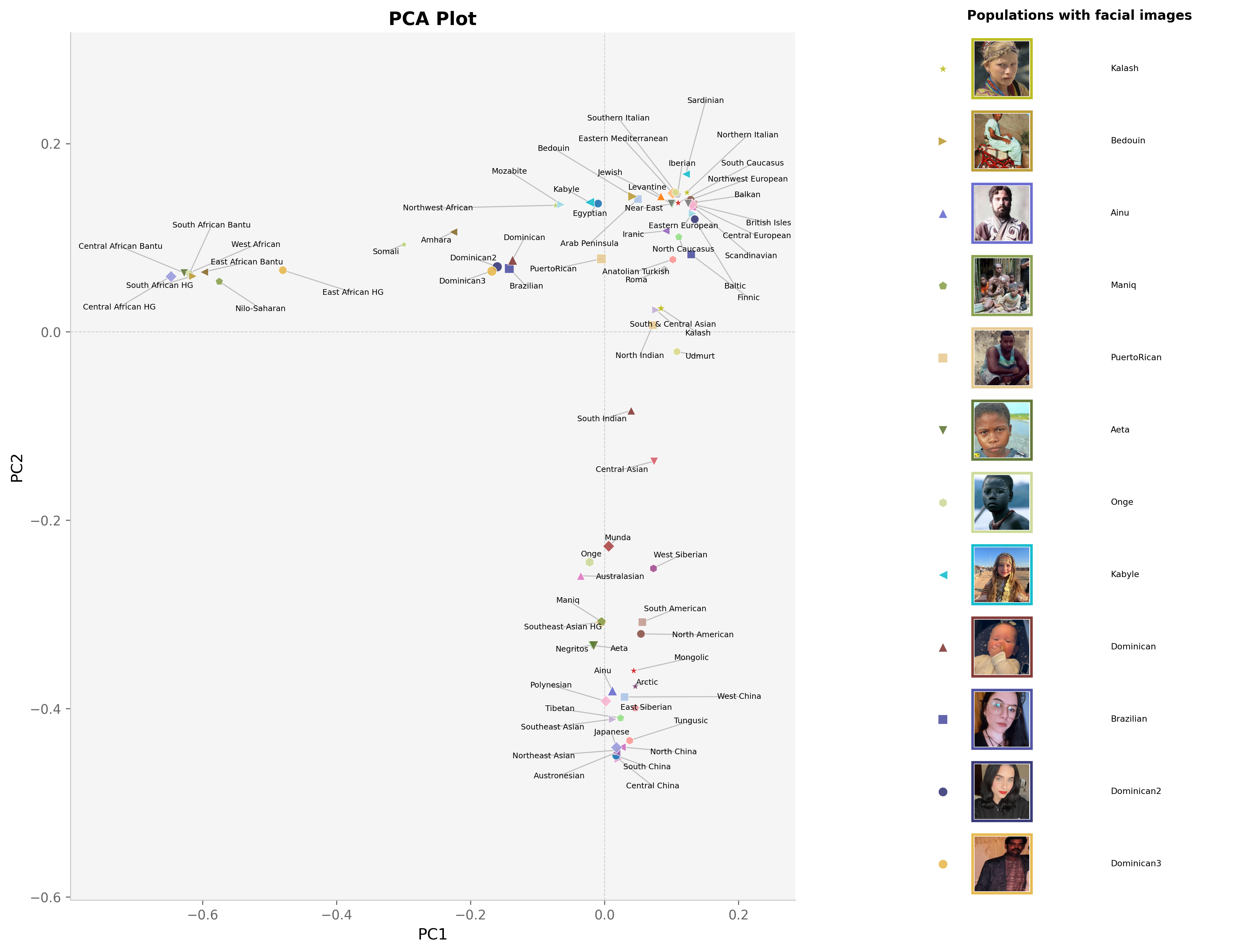
Take Dominicans. Two Dominicans with nearly identical admixture estimates can look completely different from each other. One can be light skinned with narrow features, the other dark skinned with broader features. Same percentages, completely different face and skin color. On the plot above, two of the Dominicans have light eyes and one even has light blonde hair, despite all of them clustering in the same spot. Percentages tell you nothing about what an individual actually looks like.
This is why. You inherit one allele from each parent at every gene. The pair you end up with at the genes for skin color, eye color, and facial features is what determines how you look. That pair is a coin flip at each gene - you could get the light-skin allele from your mother and the dark-skin allele from your father, or the reverse, or two of the same. Two siblings with identical parents and identical admixture estimates can look completely different because each got a different shuffle of alleles at those few dozen genes.
The same thing shows up across the plot. The Puerto Rican sits genetically closer to Europeans than the Dominicans do, yet that individual is very dark skinned. The Kabyle cluster with North Africans, not Europeans, yet some have light skin and blonde hair. The Kalash cluster with Central and South Asians, not Europeans, but the same is true for them. The Ainu, Onge, Maniq, and Aeta all plot near each other in the East Eurasian region. Yet the Ainu can look more like Europeans, while the Onge, Aeta, and Maniq can look more like Africans. Same genome-wide average, completely different appearances - because the genes that determine where you sit on this plot are not the genes that control skin color or facial features.
0.5% of your genome
The traits we use to assign racial labels are controlled by maybe a few dozen genes out of roughly 20,000 - less than 0.5% of your DNA. The other 99.5% shapes your metabolism, immune system, height, and disease risk, none of which correlate with skin color or facial features. A genome-wide admixture average cannot tell you anything about the 0.5% that controls appearance. It is like judging a library by what languages the books are in and claiming you know what the covers look like.